

Volumes
Farmland supply across England eased by around 8% in 2025 compared with 2024, with approximately 90,000 acres brought to market over the year. While that marks a modest decline year on year, it is still above the levels seen in 2020, 2021, 2022 and 2023, underlining that activity remained relatively strong by recent standards.
At a regional level, supply rose in the East and West Midlands, but fell across the East of England, the South East and the South West.
This slight reduction in supply was largely driven by uncertainty around inheritance tax considerations, with many landowners spending 2025 weighing up their options for longer-term business planning. Hopes of renewed policy support also encouraged some owners to delay potential sales.
Supply also fell in Q1 2026 compared with the same period in 2025, with continued wet weather in the early months limiting activity. Around 7,000 acres were marketed between early January and the end of March, broadly in line with our expectations.
That represents a fall of around 25% on the same period in 2025, although it is worth noting that last year delivered an unusually high volume of acreage to the open market in historic terms.
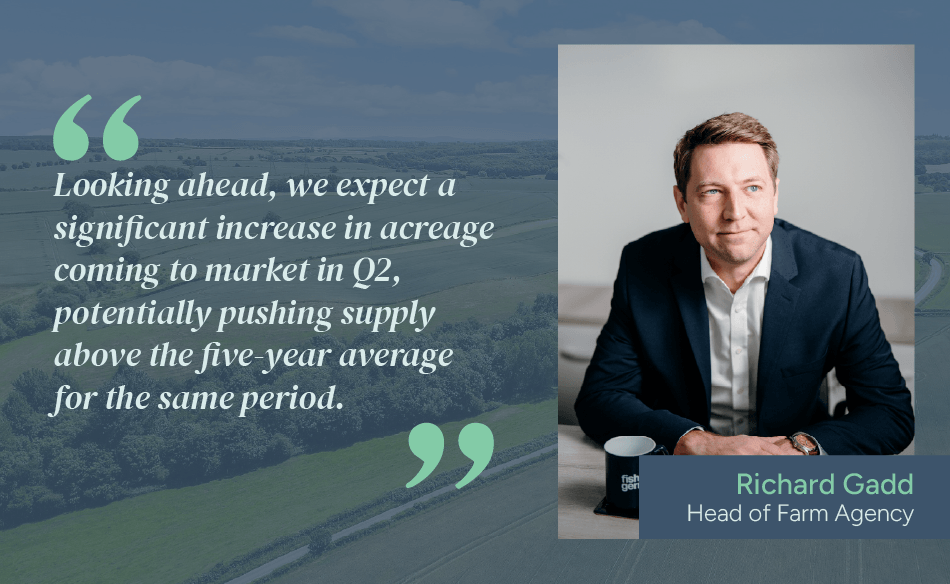
Looking ahead, we expect a significant increase in acreage coming to market in Q2, potentially pushing supply above the five-year average for the same period.
A number of vendors made the decision to sell in late 2025 but have been waiting for more suitable weather before progressing marketing material and photography.
We are also seeing a notable rise in instructions for private marketing campaigns this year. Terms have already been agreed on one commercial farm in the South East, with several other opportunities close behind.
Buyers
Buyer profiles remained broadly familiar through 2025, although we did see a reduction in demand from non-agricultural private investors and institutional purchasers.
Farmers accounted for around 60% of all buyers in 2025, while non-agricultural private investors made up roughly 20%, reinforcing the fact that farmers remain the dominant force in the market.
Rollover buyers also remained an important part of the market, particularly for larger opportunities. Limited availability in the 500- to 1,000-acre bracket helped keep values firm in that segment.
Developers and strategic land buyers remained interested in medium- and long-term freehold opportunities, although very few genuine strategic sites were brought forward. Where suitable holdings do emerge, competition is likely to remain intense, supporting further strength in capital values.
Institutional and charity-backed buyers continue to pursue genuine strategic holdings, long-term tenanted opportunities with reversionary upside, and mixed-use assets that are not solely dependent on agricultural returns. Even so, the share of farms and land sold to institutions was lower in 2025 than in 2024.
Lifestyle and amenity buyers from outside farming continue to drive demand for smaller residential farms, bare land, and holdings with diversified income streams or clear potential to add value.
Across the board, buyers are increasingly selective, favouring higher-quality holdings with limited liabilities such as redundant buildings, poor infrastructure, drainage issues or residential assets requiring substantial investment.
Encouragingly, Q1 2026 has brought a steady rise in interest from genuine farmer buyers, supported by the anticipated revival of the SFI scheme and the revised IHT and APR thresholds announced in late 2025.
Vendors
Throughout 2025 there was considerable discussion about how proposed changes to Agricultural Property Relief (APR) and Business Relief (BR) in Spring 2026 might affect the market. In practice, however, relatively few sales appeared to be driven primarily by those concerns.
Farmers remained the largest vendor group in 2025, followed by non-agricultural investors and institutions.
Within that profile, arable farmers were the main drivers of supply, facing a combination of difficult early-2025 weather, weaker yield expectations, pressure on debt serviceability and reduced subsidy support.
That said, the vendor profile in Q1 2026 is beginning to shift, with more supply emerging from institutional and charity-led sales.
Values
In 2025, land values were shaped primarily by type, scale, quality and location.
Capital growth was relatively subdued and average values softened slightly, but the spread of prices achieved remained wide. Smaller parcels of amenity and equestrian land of the right scale and quality continued to command a premium in desirable locations, while well-presented commercial farms with strong soils held their value well.
Pastureland performed slightly better than arable land overall, although regional and local variations remained significant. By the end of the year, some easing was evident in the eastern counties, while exceptional prices were still being achieved in parts of the west and south.
On average, pastureland values fell by up to 2% in 2025, while arable values declined by around 4%. These figures should be treated with some caution, however, as strong regional differences continue to influence national averages.
One of the clearest trends carried over from 2024: the very highest prices paid for farmland have become less common. After years of widening, the gap between the lowest and highest values achieved is now beginning to narrow.
Average arable land values across England now stand at around £10,300 an acre, while pastureland averages approximately £8,400 an acre. Even so, marked differences remain between counties and, in some cases, even between neighbouring parishes.
It is still too early to draw firm conclusions on average values for 2026, given the limited volume of transactional evidence available so far.
Looking Ahead
Looking ahead, we expect supply to rise moderately in 2026, driven by a combination of natural retirement sales, smaller disposals by farmers looking to release capital for diversification, and the need to reduce debt.
We also anticipate a marked increase in supply during Q2 2026, which could bring the end-of-H1 total in line with, or even above, the same point last year.
The reopening of SFI in 2026 is likely to have a greater impact on buyer demand than on supply. For most vendors who have already decided to sell, the scheme is unlikely to alter that decision.
The partial reversal of APR and BR policy in late 2025 may encourage some small and mid-sized operators to postpone sales where tax exposure had been a factor, although we believe the number of cases where this is truly decisive remains limited.
Buyers
The overall buyer profile in 2026 is likely to look much like 2025, although we expect more farmer buyers to return on the back of improved APR thresholds and a more positive outlook for environmental scheme payments.
Corporate and private investor demand is also expected to remain for carbon opportunities, offsetting and rewilding. While these buyers still represent a relatively small share of the market overall, their presence continues to influence both demand and pricing where they are active.
Institutional and charity-backed buyers are expected to stay active in the market for genuine strategic holdings, longer-term tenanted opportunities with reversionary uplift, and mixed-use assets that are not wholly dependent on agricultural returns.
Traditional farmer buyers are likely to remain focused on local and neighbouring opportunities that offer scope for expansion, despite continued pressure on input costs and the challenges succession can bring. With interest rates holding at current levels, borrowing may remain less attractive for some.
Vendors
We expect the vendor profile to change little in 2026, although institutional disposals may increase where lower-yielding assets with liabilities are traded for more strategic holdings.
Farmers are still expected to remain the principal vendor group.
Values
Our short-term outlook for farmland values remains steady, although we do not expect strong volumes of completed transactions or market evidence in H1 2026, as most 2026 sales are more likely to conclude in the second half of the year.
We expect both arable and pastureland values to remain broadly firm, with the reopening of the SFI scheme offering some reassurance that support will be available to offset existing pressures.
Strategically located sites with long-term planning potential should continue to attract strong interest and robust values.