

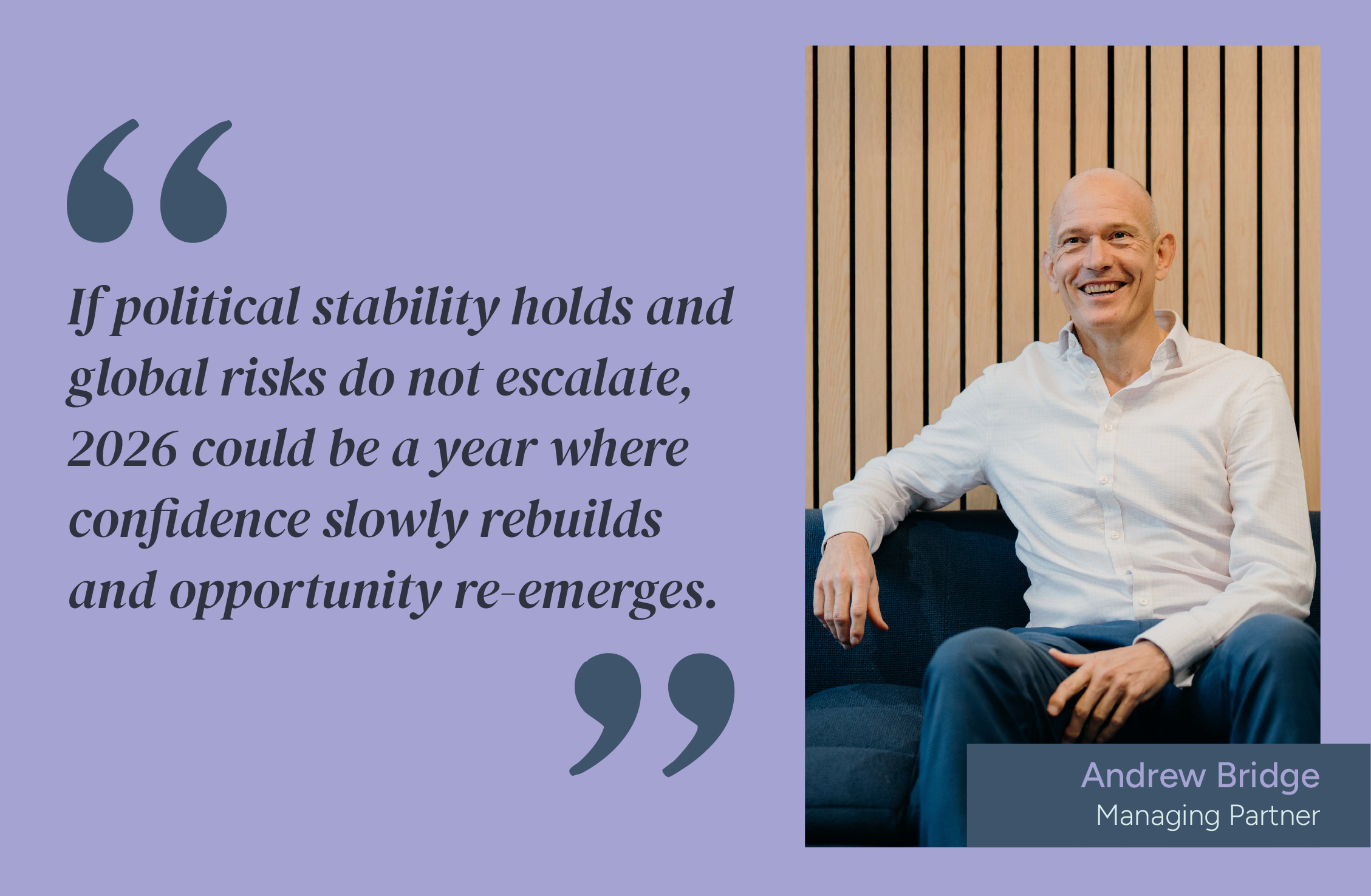
Following the challenges faced by the property sector in 2025, we spoke with our Managing Partner, Andrew Bridge, to gain insight into his perspective on whether economic stability may lead to increased confidence and activity within land, residential, and commercial markets in the coming year. He argues that 2026 could mark a cautious turning point for property leaders, provided several significant economic, political and geopolitical assumptions hold firm.
When I look back at 2025, resilience has been the defining characteristic of the property sector. Political change, legislative reform and high interest rates combined to keep many decision-makers firmly on the sidelines, and the impact of the changes to the NPPF have yet to become clear.
This has created pent-up demand that could begin to surface in 2026 if the macroeconomic signals continue to move in the right direction.
However, this latent activity will depend on a lot of assumptions that are very much up in the air given how quickly things can change on the world stage.
My base case for 2026 assumes that the Bank of England base rate falls to between 3 and 3.25 percent by the end of the calendar year, CPI drops below 2 percent, and unemployment continues to rise modestly. That balance is far from perfect, but it would represent a more stable platform than we have seen for some time.
There would also need to be no change in Prime Minister or Chancellor, which is very hard to predict with certainty. The second is that there are no major geopolitical escalations in places such as Greenland, Venezuela, or Iran. If either of these proves wrong, confidence will evaporate quickly.
Assuming relative stability in these areas, I expect to see small growth in land values through 2026, driven not by volume but by competition for the best sites. Appetite remains strong for high quality land in prime locations, particularly where there is clear planning logic, infrastructure access or long-term strategic value.
In my view, land will continue to be seen as a long-term store of value rather than a short-term trade.
The residential market is likely to be more fragile. I expect transaction levels to remain relatively static overall, although there is scope for an uplift as pent-up demand begins to release.
Many households have delayed decisions for the past two years, and even small reductions in mortgage costs could prompt movement. Buyer confidence will play a massive role in how the market fares as the year goes on.
Commercial property is where I see the clearest opportunity for renewed momentum. Improved clarity on interest rates and a sense that values have largely reset should drive an increase in transactions. I expect 2026 to bring more deals, more restructuring and more opportunities for those prepared to engage actively with their assets rather than wait for the market to do the work for them.
Across all sectors, the lesson from recent years is that adaptability matters. Legislative reform, from planning to taxation, continues to reshape decision-making, while occupier expectations around sustainability, flexibility and value for money are only intensifying. For property leaders, success in 2026 will come from understanding these pressures and responding early, not from assuming a return to old patterns.
My overall view is cautiously optimistic, but conditional. The direction of travel feels more positive than it has for some time, yet the foundations remain fragile. If political stability holds and global risks do not escalate, 2026 could be a year where confidence slowly rebuilds and opportunity re-emerges.
For Fisher German’s part, we have taken on over 160 new members of staff in the last year, including six new partners, to guide our clients through these challenging markets.
Those who stay disciplined, focus on quality and take a long-term view will be best placed to lead through the next phase of the property cycle.