
After several turbulent years for agricultural policy, DEFRA’s announcement of the redesigned Sustainable Farming Incentive (SFI) for 2026 feels like a much-needed reset. We caught up with David Kinnersley, Partner and Head of Agribusiness, to learn why this announcement is less about headline policy announcements and more about something far simpler, clarity, confidence and the ability to plan.
The new SFI offer, unveiled at the National Farmers’ Union conference on 24 February, signals a clear shift in approach. It recognises the reality facing farming businesses since the loss of the Basic Payment Scheme (BPS) and attempts to restore trust after the abrupt closure of the previous SFI offer in 2025. Confidence in policy delivery has been badly shaken and rebuilding it will be critical if environmental land management schemes are to succeed.
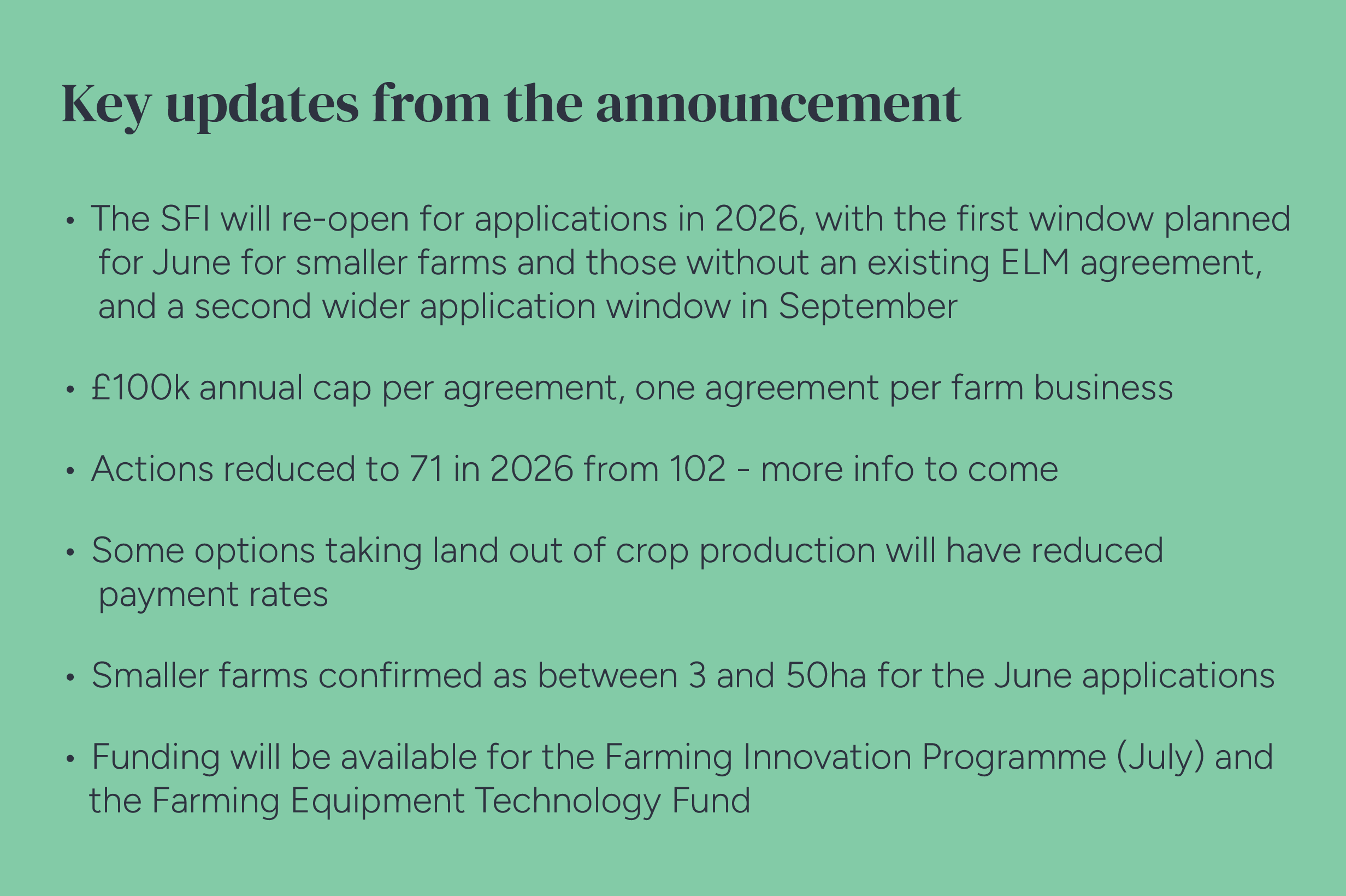
At its core, the redesigned SFI aims to be more accessible and more predictable. Applications will reopen this year, with an initial window in June for smaller farms and those without existing Environmental Land Management schemes (ELMs) agreements, followed by a wider window in September. This phased approach is sensible. It acknowledges that not all businesses are starting from the same place and gives those previously excluded a clearer route back into support.
Perhaps the most welcome change is simplification. Reducing the number of actions from 102 to 71 may sound technical, but in practice it addresses one of the most consistent frustrations we hear from clients, complexity. Fewer actions, with clearer structure, should make it easier for farmers to assess what is achievable on their land and integrate SFI into their wider business plans without excessive administrative burden.
The introduction of a £100,000 annual payment cap per farm business will undoubtedly attract debate. Larger enterprises will feel the constraint more keenly, but DEFRA’s position is clear: around 97% of farms are expected to fall below the cap. In that sense, the policy is designed to distribute funding more evenly and ensure smaller and medium‑sized farms can secure meaningful levels of support for delivering environmental outcomes.
That balance between fairness and functionality is important. SFI is not simply a replacement subsidy. Payments are explicitly tied to the delivery of public goods, improved soil health, biodiversity, water quality and carbon storage. For many businesses, this requires a shift in mindset, from short‑term income replacement to longer‑term land management strategy.
What is also encouraging is the recognition that farming does not operate in isolation. The redesigned SFI allows non‑farm rural businesses and land managers with appropriate control of land to participate, opening the door to broader engagement across the countryside. Combined with the additional £345 million announced for innovation and productivity, supporting investment in technology, equipment and new practices, there is real potential for diversification and resilience beyond traditional farming models.
That said, challenges remain. While the menu of actions is smaller, choosing the right combination to maximise both environmental impact and financial return will not be straightforward. Businesses will need to think carefully about how SFI fits alongside food production, tenancy arrangements and longer‑term succession planning. Advice and careful modelling will be essential.
This is why stability matters so much. Environmental schemes only work if land managers believe they can commit with confidence. The early closure of the previous SFI offer undermined that trust and rebuilding it will take time. The 2026 reset is a step in the right direction, but delivery will matter as much as design.
Ultimately, SFI 2026 is not a silver bullet, but it is a more pragmatic, workable framework than what came before. If DEFRA can maintain consistency and resist further stop‑start changes, this scheme has the potential to support both sustainable food production and a thriving rural economy. For farming businesses navigating an increasingly complex landscape, that stability may prove just as valuable as the payments themselves.
While challenges remain, particularly in planning the most effective combinations of actions to maximise value, this reset of the SFI lays a more stable foundation for agricultural businesses to adapt, grow and thrive in the years ahead.
Find out more about SFI26.