

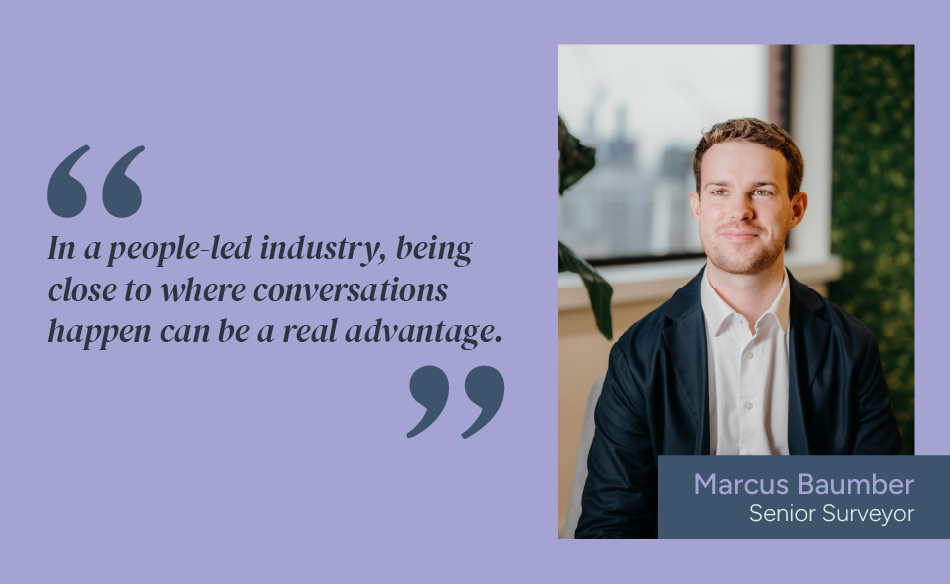
After three years of commuting into Manchester, Marcus Baumber, a Senior Surveyor in our commercial agency team, moved from the suburbs into the city centre and quickly realised the biggest benefit wasn’t just time saved, but friction removed. Here, he shares his take on what changed day to day, why proximity still matters in a flexible-working world, and what employers often underestimate about “place”.
What prompted your move to Manchester, and how has that changed your day-to-day life?
It was mainly lifestyle. I grew up in the suburbs, lived with my parents, and wanted my own routine. I’d worked in Manchester for three years, so I knew what I was missing while driving in and out. The practical change was immediate: my commute is now a 10‑minute walk, not an hour’s drive. That doesn’t just save time, it helps to change your work-life balance. I can train in the morning and start work feeling calmer. In the evenings I have real free time, not free time minus traffic. You don’t realise how draining commuting is until it’s gone.
Was the move driven more by lifestyle, career opportunities, or a mix of both?
A mix of both. Socially, it’s easier to see friends after work without planning your whole night around travel. Professionally, being in the city puts you closer to clients and opportunities, and it’s simpler to say yes to something last minute when you’re already nearby.
What do you enjoy most about living and working in Manchester city centre?
Everything is close. Manchester is thriving and there’s always something going on, new openings, events, pop-ups, gigs. Living in the centre means you don’t have to “make a night of it” to enjoy the city, you can meet friends or clients after work without thinking about trains, parking, or the drive home.
How has being closer to work impacted your work-life balance?
Very positively. Less commuting means more flexibility before and after work, for exercise, seeing people, or switching off earlier. I’ve gained close to two hours a day back, and it makes the working week feel lighter.
Do you feel more connected to your colleagues, clients, or the business community by being based in the city?
Yes. Being based in the city makes it much easier to meet clients for a coffee or a drink after work, and regular face-to-face time feels more natural. In a relationship-driven industry, those informal catch-ups build trust. Proximity also matters for the bigger picture: this is a people business, and in agency work your network is everything. Being nearby is what makes the quick meeting happen, the event you actually attend, and the relationships you keep active over time.
Why is city-centre office space appealing to professionals today, and does it give businesses an advantage when attracting talent?
It’s the mix of convenience and connectivity. Being in the centre puts you close to peers, clients and the wider business community, so office days feel more useful and more social. For employers, that location usually helps with recruitment too, because city-centre workplaces are easier to access via transport links and tend to offer the lifestyle appeal many people want.
How important are amenities, culture and the social scene when choosing where to work, and do younger professionals prioritise city-based roles because of that?
It’s a big factor, especially early in your career. City-centre roles make it easier to build a community and network through events and chance encounters, and the surrounding environment matters too. Good amenities and social options can be the difference between an office people choose to visit and one they avoid, even small things like decent lunch spots or a Friday drink nearby.
How do you think expectations around where people work has changed in recent years?
Expectations have shifted. With working from home, the office isn’t the only place people can work, so offices have to offer more than a desk. If you’re asking someone to come in, the building and the surrounding area need to make it worthwhile.
How important is flexibility versus location when it comes to choosing an employer?
Both matter, but flexibility is central now. The aim is to give people options, then make office days valuable when they do come in. Flexibility hasn’t killed the city-centre office, it’s raised the bar. If the office is optional, location, experience and quality become the reasons people choose it.
What makes Manchester attractive for businesses, and are more clients prioritising city-centre space to support recruitment and retention?
Manchester offers scale, a diverse talent pool and strong connectivity, with good transport and a proactive local authority, at a more competitive cost base than London. In the market, location remains a top priority for many occupiers. Even with more flexible working, businesses still want a central hub, and the wider flight to quality is pushing demand toward best-in-class Grade A space, often in the city centre.
Looking back, is moving into the city one of the best decisions you’ve made?
Yes, without hesitation. In my mid-20s, I love living somewhere busy with loads to do. It’s improved my work-life balance, my social life, and it’s helped me meet new people, professionally and personally.
What would you say to someone considering a similar move?
Go for it if you value convenience, social opportunities, and a faster pace of life. You’ll say yes to more and feel more connected. But it isn’t for everyone, city living can be busy and noisy, spaces are often smaller, and you pay a premium for the postcode.
In three words, how would you describe working life in Manchester?
Vibrant. Ambitious. Opportunity.