

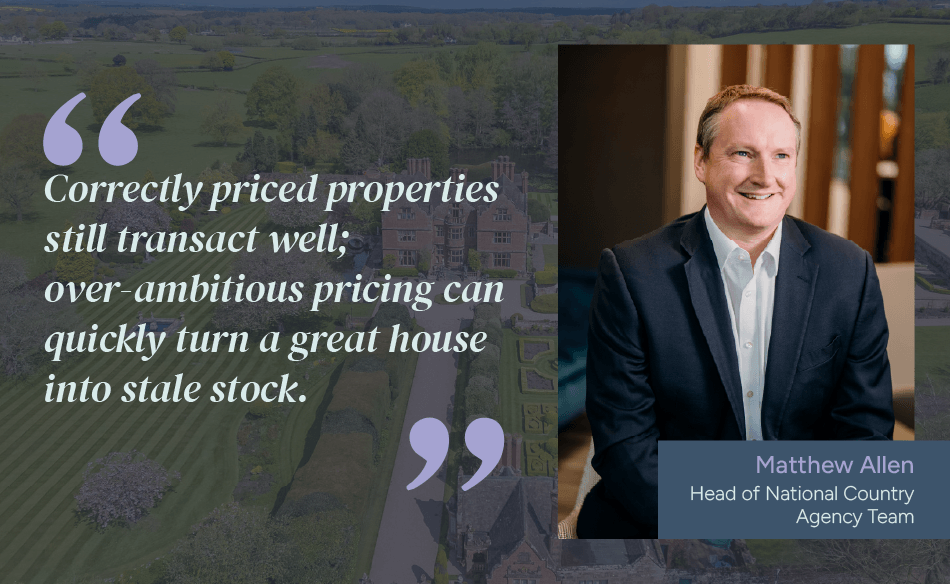
This early summer market shows quality properties still generating strong interest, while assets with compromises in location, presentation, or overpricing are slower to sell. Matthew Allen, Partner and Head of National Country Agency Team (NCAT), explains that buyers remain active but have become more selective and value-focused.
Is there still a ‘race for space’?
Yes, but it has evolved. The post-pandemic “more space at any cost” mindset has been replaced by a location- and lifestyle-led search where “best in class” is the clear winner. Prime areas such as the Cotswolds, Cheshire and established commuter pockets across the Midlands have held firm, underpinned by long-term scarcity and enduring desirability.
What does today’s prime buyer want?
In today’s market, buyers are overwhelmingly gravitating towards finished, turnkey homes. Larger farmhouses and country properties that need significant improvement are less favoured, not because the appetite for character has gone, but because the unknowns around cost, contractors and timeframes feel harder to justify. By contrast, superb modern homes with strong eco-efficiency credentials, in the right location, continue to attract genuine demand. Home-working space remains important, but it’s increasingly viewed as part of a complete lifestyle package alongside gyms, outdoor living and practical day-to-day flow.
London equity and the pull of the commute
London is still in a recovery phase, and that matters because confidence and equity released in the capital typically filters into the country market. Hybrid working remains a factor, but there is now greater pressure for London-based movers to be at their desk in the City more often. The result is a renewed focus on homes that remain within striking distance of a daily commute, particularly across the Home Counties, whereas more remote relocations are facing tougher scrutiny unless the property is exceptional.
Is there enough quality stock at the top end?
Stock levels have risen during the spring and early summer period, but that supply includes some country houses that failed to sell last year. That makes pricing absolutely critical. There remains a gap between some vendor expectations and where buyers are prepared to position themselves, and it is often the more motivated or “forced” seller who ultimately must compromise. Correctly priced properties still transact well; over-ambitious pricing can quickly turn a great house into stale stock.
How are sustainability credentials influencing decisions?
Running costs are back on the agenda. With recent spikes in gas and oil prices driven by global events, buyers are asking sharper questions about how a home will perform day to day. At the same time, the upfront cost of many renewable solutions remains high, so “sustainability” is most persuasive when it’s delivered as a coherent package, good insulation, sensible heating systems and proven performance, rather than a long list of expensive add-ons.
Are international buyers still active?
International buyers, particularly US-led, remain in play for the right property and will often move quickly when they see something rare. More broadly, periods of heightened geopolitical uncertainty can influence where internationally mobile families choose to base themselves, and we can see renewed interest from British expats reassessing plans in markets such as Dubai and the wider UAE.
Time to sell, or time to sit tight?
For vendors who are hesitant, the key question is motivation. If life demands mean you need to move, there is still a real window to achieve an excellent result provided the home is presented well and priced competitively. Where buyers sense value, they will act; where they sense “testing the market”, they will wait. In a policy environment where future tax changes are never far from the headlines, certainty and decisiveness can be a competitive advantage.
Hot spots: where is outperforming?
The usual suspects are leading: the Home Counties, proven commuting locations, and the Cotswolds. In tougher conditions, buyers often revert to what they know best, areas with established schools, amenities, transport links and a track record of liquidity.
Outlook: the next 6–12 months
I expect the market to remain cautious over the next six to 12 months, with pricing discipline the deciding factor. If global tensions ease, inflation continues to moderate and borrowing costs become more competitive, confidence should improve and transactional activity will follow. Until then, the opportunity lies in realism: buyers will pay well for the right house in the right place, but they will not overpay for uncertainty. The prime market is definitely open for business, but it is rewarding quality, clarity and correct pricing, not optimism.