

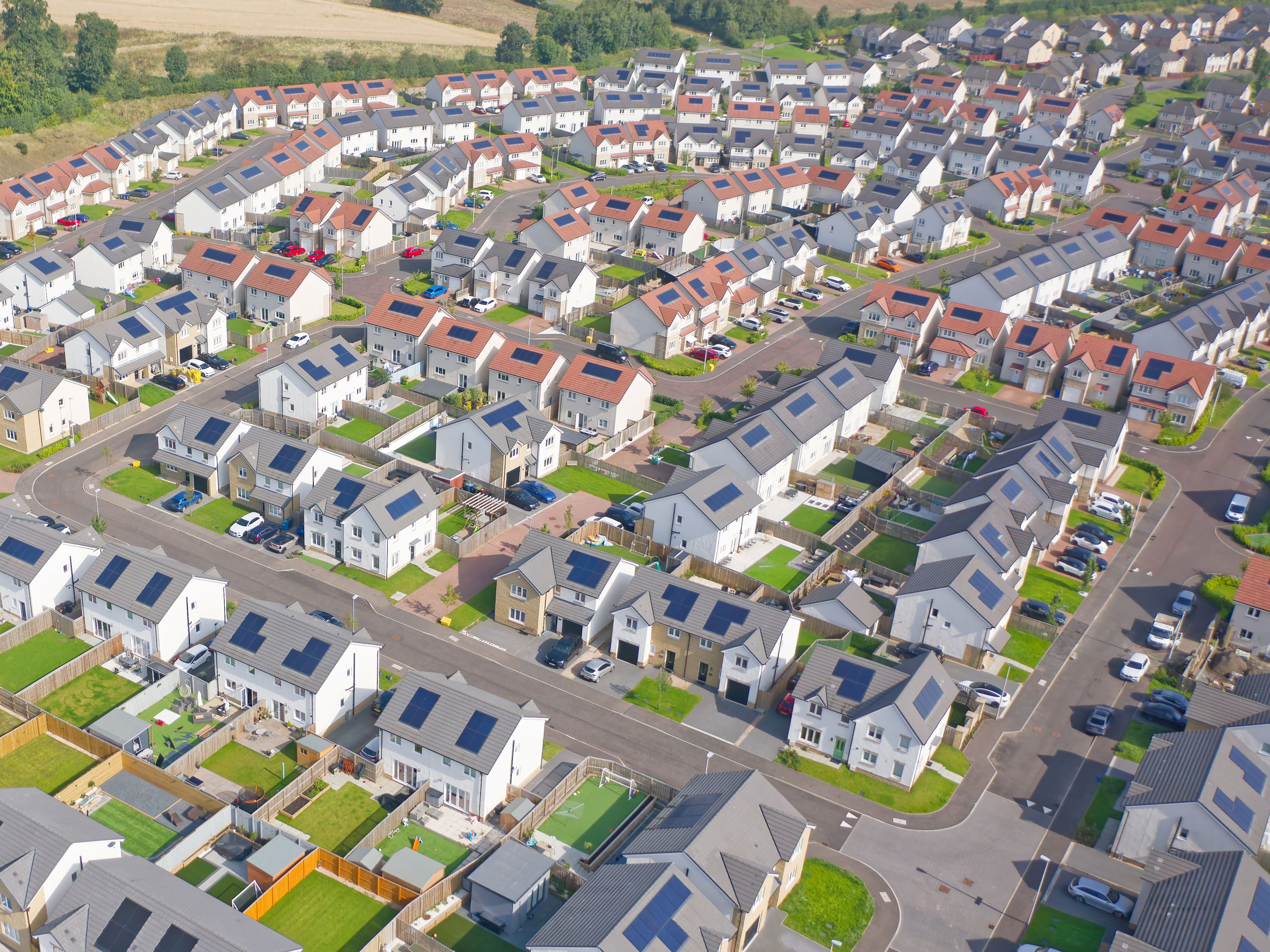
In a landmark move for the housing sector, the UK government has confirmed that rooftop solar panels will be a “default” feature on new build homes under the upcoming Future Homes Standard (FHS), set to be published this autumn. The policy mandates that new homes will include solar photovoltaic (PV) panels covering at least 40% of the roof area, with allowances for practical limitations such as shading or orientation.
The announcement, made jointly by the Ministry of Housing, Communities and Local Government (MHCLG) and the Department for Energy Security and Net Zero (DESNZ), marks a significant shift in building regulations. It aims to ensure that nearly all new homes are equipped with renewable electricity generation, primarily solar, alongside low-carbon heating systems like air source heat pumps.
Luke Brafield, Partner and Head of Residential Development in our development agency team, offered a measured view from the new homes development perspective. He said: “While the ambition behind the FHS is commendable, we’re seeing the requirements increasingly treated as a cost rather than a value-add in the market.
“This is already impacting land values in several transactions we’re involved in. The uncertainty around the implementation timeline is also creating a mixed response from housebuilders, some are factoring in the additional costs and offering overage if the standard isn’t implemented, while others are excluding it entirely from their appraisals. Greater clarity and consistency will be key to ensuring the policy supports, rather than disrupts, housing delivery.”
The FHS is designed to significantly reduce carbon emissions from new homes, which already emit on average a third of the carbon of older properties.
Darren Edwards, Partner and Head of Green Energy and Sustainability, emphasised the broader environmental and economic benefits. He said: “Embedding solar into the DNA of new housing developments is a game-changer. It’s not just about reducing emissions, it’s about creating homes that are future-proof, resilient, and affordable to run.
“This policy accelerates our transition to clean energy and supports the UK’s net zero ambitions. We’re excited to lead the charge in delivering homes that are as smart as they are sustainable.”
“At a time when grid connectivity and power into new developments is a material constraint, actions to reduce demand are a positive step.”
The FHS will also include enhanced energy efficiency standards, improved ventilation, and smart technologies to optimise energy use. Industry leaders, including the Home Builders Federation and the Future Homes Hub, have expressed support for the policy, while calling for a streamlined implementation process to avoid delays in housing delivery.
As the sector prepares for the FHS rollout this autumn, developers, suppliers, and policymakers are aligning to ensure that the next generation of homes is not only greener but also more comfortable and cost-effective for residents.