

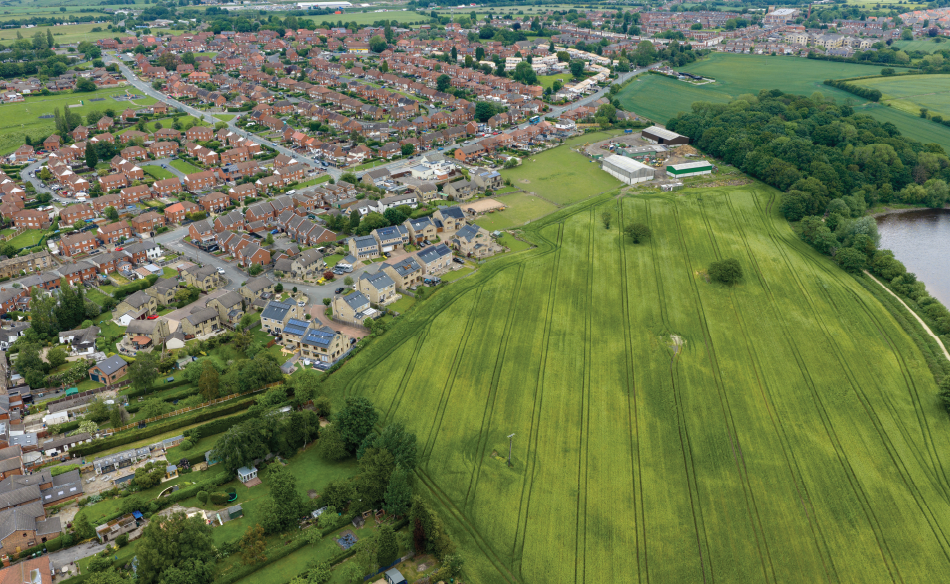
For many farmers, estates and rural landowners, strategic development can feel both full of opportunity and difficult to judge. A parcel of land on the edge of a settlement, near existing infrastructure or close to a future growth area may have short, medium or long-term potential but recognising that potential is only the starting point.
In practice, bringing land forward is rarely quick, but that does not mean landowners should wait. It can take years to move from early appraisal to allocation, planning permission and eventual disposal, and during that time policy, local authority priorities and market conditions can all change. Where there is a credible planning opportunity, the priority is to be ready to act: landowners need strong evidence, clear objectives and the right advice in place so they can move quickly when the window is open.
We asked Richard Gadd, Partner and Head of Farm Agency, what landowners should be thinking about before bringing land forward for strategic development, and why early preparation can make such a difference.
Start with a realistic view of potential
The first question is not simply whether land could be developed, but whether it is likely to be supported through the planning system under local or national policy. Location remains critical and land adjoining a sustainable development, with access to roads, services, schools and employment, will usually be looked at very differently from an isolated block of open countryside.
A sensible appraisal should look at local plan status, housing land supply, settlement hierarchy, landscape sensitivity, access, drainage, ecology, agricultural land quality and nearby constraints. It should also consider whether the land forms part of a wider opportunity. Sometimes a site only becomes viable when considered alongside neighbouring ownerships or future infrastructure improvements.
Richard explains: “Strategic development is about understanding where your land sits in the bigger picture. A field may look promising on a plan, but the detail matters. Access, services, policy support and deliverability all influence whether it is genuinely worth promoting.”
Understand the timescales involved
One of the most important points for landowners to appreciate is the length of the journey. Strategic land promotion can involve local plan representations, technical work, consultation, planning applications, appeals, infrastructure negotiation and legal structuring. For larger sites, this may take many years.
That does not mean landowners should wait until a local plan review is already underway. In many cases, the strongest position is built well in advance, with constraints understood, evidence prepared and professional advice in place before a formal opportunity arises.
“The landowners who are best placed are usually those who have done the quiet work early,” says Richard. “They know what they own, what the constraints are and what outcome they would be prepared to accept. That preparation gives them more control when approaches are made.”
Get ownership, title and occupation matters in order
Before entering detailed discussions with a promoter, developer or neighbouring landowner, it is important to establish who owns what, how the land is occupied and whether anything could prevent delivery. Historic family ownership, informal grazing arrangements, rights of way, easements, restrictive covenants, access issues and unregistered land can all slow progress if they are discovered too late.
Vacant possession can also be a key issue. Land subject to agricultural tenancies, licences or informal arrangements may still have development potential, but the route forward needs careful handling. Early legal and agency advice can help identify issues before they become barriers to negotiation.
For family businesses and estates, ownership clarity is also about decision making. If several family members, trustees or business partners have an interest in the land, their objectives need to be understood from the outset. Strategic development can create significant value, but it can also expose differences in appetite for risk, timescale and legacy.
Choose the right route to market
There is no single structure that suits every strategic development opportunity. Some landowners may prefer an option agreement with a developer, others may favour a promotion agreement, conditional contract, hybrid arrangement or collaboration with adjoining owners. Each approach carries different implications for control, risk, cost, tax, timing and value.
A promoter may fund the planning process and then share in the uplift once permission is achieved. A developer option may offer a clearer route to sale but can place more emphasis on how value is calculated at the point of exercise. Collaboration agreements can be essential where several ownerships need to come forward together, particularly where infrastructure, access or developable land is unevenly distributed.
Richard adds: “Landowners should not just focus on the headline percentage or price. The detail of the agreement matters enormously: who controls the planning strategy, how costs are treated, how value is assessed, what happens if policy changes and how long the land is tied up.”
Think carefully about tax, succession and the wider business
Strategic development should never be looked at in isolation from the wider farm, estate or rural business. A potential land sale may affect succession plans, borrowing, business structure, inheritance planning, reinvestment strategy and the long-term viability of the holding.
Tax advice should be taken early, not at the point a deal is about to complete. Capital Gains Tax, Inheritance Tax, VAT, overage, deferred payments and the treatment of promotion or option structures can all materially affect the outcome. The best commercial agreement may not be the best overall agreement if it creates unintended tax consequences or conflicts with succession objectives.
It is also worth separating what is core to the farming enterprise from what may be capable of change. Some land may be central to business operations, environmental schemes or family identity. Other parcels may be more flexible. Understanding that distinction helps landowners decide what they would be prepared to bring forward, and on what terms.
Do not underestimate infrastructure and community expectations
Strategic development is increasingly judged on more than housing numbers or land value. Deliverability, infrastructure, design quality, biodiversity, drainage, access, public open space and community benefit all carry weight. Sites that appear attractive in principle can become difficult if they cannot demonstrate how they will work in practice.
Landowners do not need all the answers at the outset, but they should understand the likely pressure points. Where will access come from? Are there capacity issues with roads, schools or utilities? Are there flood risk or drainage concerns? Can biodiversity net gain be delivered on site, or will off-site land be required? These questions affect both planning prospects and eventual value.
Community response also matters. Local opposition may not prevent a sound scheme, but poor engagement can make the process harder. A clear narrative around need, design, infrastructure and local benefit can help demonstrate that a proposal is not simply being imposed on a place but has been properly considered.
Keep control of the long-term legacy
For many landowners, strategic development is not simply a financial decision. It may affect land that has been held for generations, shape the edge of a village or town, and influence how a family business evolves. That makes legacy an important part of the conversation.
Legacy can mean different things: protecting the retained farm, securing long-term income, creating well-designed places, supporting the next generation, funding diversification or reducing exposure to future policy and tax change. The key is to define those priorities before negotiations begin, rather than trying to recover them later.
The best outcomes come when landowners are clear about what success looks like and that might be maximum value, but it might also be control, timing, retained ownership, infrastructure improvements or protecting the wider holding. Those priorities should shape the route chosen.
Preparation puts landowners in a stronger position
In a changing planning environment, landowners may be tempted either to rush forward or to do nothing until policy becomes clearer. Neither approach is ideal. The more balanced position is to prepare carefully, understand the opportunity and decide deliberately whether, when and how to act.
That means taking early advice, reviewing ownership and occupation, assessing planning prospects, considering tax and succession, and being clear about commercial objectives. It also means keeping land under review as local plans, housing need, infrastructure investment and policy direction evolve.
Strategic development will not be right for every holding, and not every piece of land with theoretical potential should be promoted. But where the fundamentals are strong, preparation can make the difference between reacting to an approach and shaping an opportunity on the landowner’s terms.
Landowners do not need to have all the answers immediately, but they do need to ask the right questions early. Strategic development is a long game. The more informed you are at the start, the better placed you will be to protect value, manage risk and make decisions that fit the future of the farm or estate.