

The industrial and logistics market has demonstrated remarkable resilience over the past few years.
Despite economic uncertainty, demand for high-quality employment land continues to outstrip supply, driven not only by traditional logistics operators but increasingly by sectors including advanced manufacturing, defence and data centres.
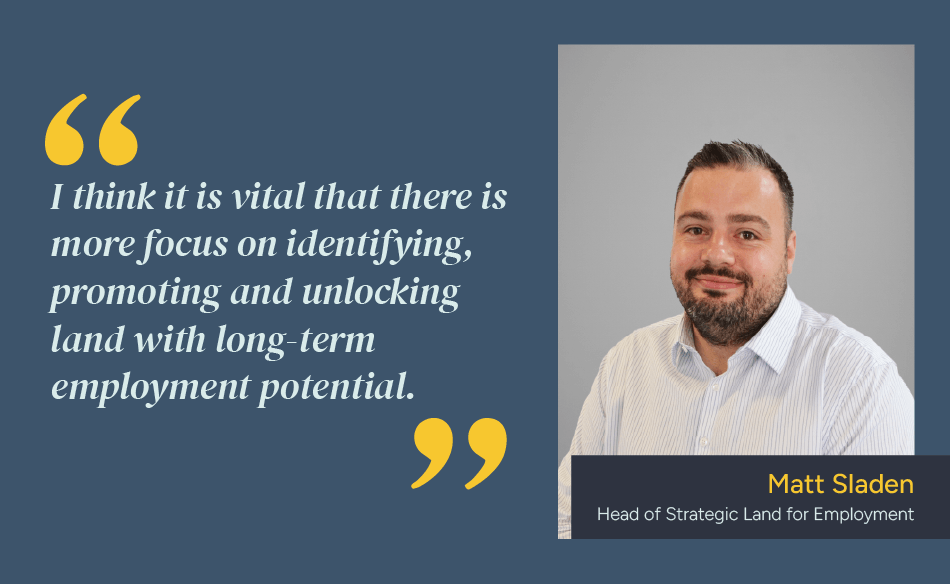
We caught up with Matt Sladen who recently joined us as Head of Strategic Land for Employment to learn more about why he believes that although the industrial and logistics market is evolving rapidly, one of the biggest challenges remains the supply of suitable development land.
Attention has been predominantly focused on completed developments and investment transactions, but the real opportunity is much earlier in the development lifecycle.
Rather than simply advising on sites that already have planning permission, I think it is vital that there is more focus on identifying, promoting and unlocking land with long-term employment potential.
This would enable landowners to maximise value from their land while creating opportunities for developers, investors and occupiers further down the line.
At Fisher German, we are currently working on strategic land projects for industrial, logistics and other employment uses at various stages of the promotion and planning process which have the potential to deliver more than 36 million sq ft of development.
That represents not just future buildings, but jobs and investment which are vital for economic growth across the UK and for the Labour Government to fulfil its election manifesto.
Many landowners occupy sites that have never been assessed for commercial development potential or have historically been considered only for agricultural or residential uses.
With the Government reforming planning policy and occupier requirements changing rapidly, land that may once have been overlooked could now present significant long-term value.
Strategic land promotion enables those opportunities to be realised through a carefully managed process, from identifying suitable sites and negotiating promotion or option agreements through to securing planning consent and bringing the land to market.
In the past, developers have approached landowners directly in an attempt to secure off-market agreements. Those offers can appear attractive, but they do not always maximise long-term value.
Landowners should take a step back and pause for thought by asking independent advisers to assess the market objectively since this may lead to competition and help them to secure the best possible price.
By identifying strategic sites much earlier in the process, we're helping landowners unlock value while creating opportunities that support future business investment, employment and economic growth.
It is really important to work with clients throughout the entire lifecycle of a project, from identifying development potential through planning, disposal, leasing, investment and long-term management.
This integrated approach delivers better outcomes for landowners and creates lasting value for everyone involved.
Industrial property continues to attract strong investor interest, while occupier demand is broadening beyond traditional logistics businesses.
As the UK economy continues to evolve, sectors such as advanced manufacturing, defence technology and data centres will require well-located employment land capable of accommodating increasingly larger developments.
Meeting that demand will require forward-thinking rather than waiting for land shortages in the future.
By investing in strategic land promotion now, the industry can create a healthier development pipeline, provide greater certainty for occupiers and ensure landowners are properly rewarded for the opportunities that are available.