

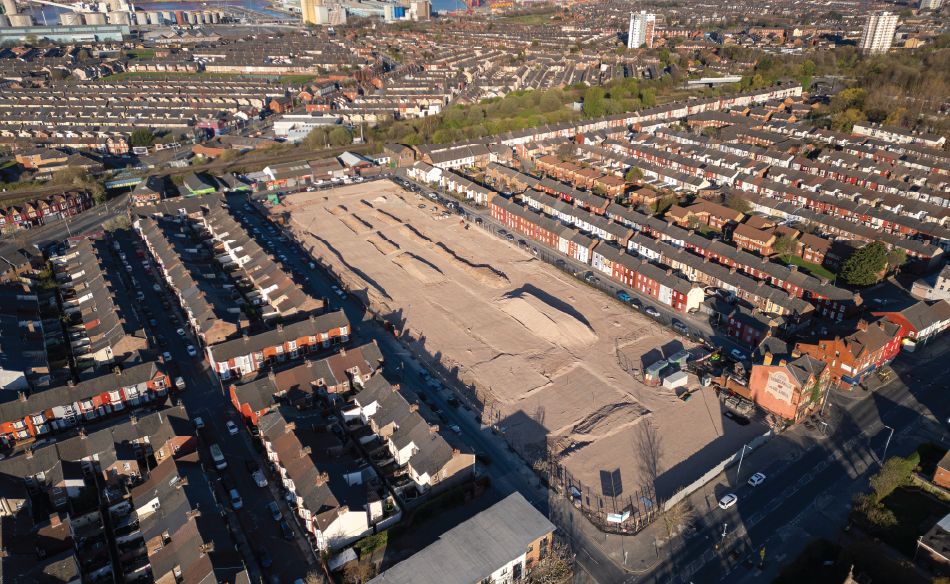
Andy Burnham’s pledge to unlock public-sector brownfield land will strike a chord with a development sector keen to see underused sites brought back to life. Done well, brownfield regeneration can support town centres, make better use of existing infrastructure and reduce pressure on greenfield land. But the route from political commitment to completed homes is rarely straightforward.
A recent article about Burnham’s housing ambitions in the, Financial Times, outlined, that the current residential market is facing challenges. Housebuilders are contending with reduced demand, rising costs, tighter margins and increasing regulation. Brownfield land has an important role to play, but difficult sites will not come forward unless the economics stack up.
Partner Alex Isles, who works in our development agency team, said: “There is a clear political push to make better use of brownfield land, and that is welcome where sites can be made viable. But these sites often come with costs and constraints that are not immediately visible. If they are not understood early, they can quickly undermine delivery.”
National policy may put brownfield first, but delivery depends on more than designation. Across the country, previously developed sites often require targeted intervention, careful viability assessment and early technical work to address remediation, abnormal infrastructure, access, servicing and planning complexity. The key question is not simply whether land is brownfield, but whether it is genuinely deliverable.
The revised National Planning Policy Framework strengthens that brownfield-first message, while also acknowledging that previously developed land alone will not meet housing need in every area. Its stronger support for higher-density development around transport hubs and well-connected railway stations follows the same logic: sustainable growth should make better use of locations where infrastructure, connectivity and services already exist or can be strengthened.
Supply is also a factor. Location is key with some regions having a meaningful list of suitable brownfield land, while others with acute housing need have very little. A brownfield-first approach therefore needs to sit alongside realistic strategic land release, especially where growth depends on new infrastructure, employment space and mixed-use communities at scale.
There is also a wider question about who delivers this land. If a future government looks again at public ownership or state-backed delivery vehicles in sectors deemed nationally important, housing could see a stronger public-sector role. That may provide certainty in some circumstances, but it would still need practical delivery expertise, viable funding models and enough developable land in the right locations.
Future tax policy could also influence whether land is developed. Any move to increase Capital Gains Tax, so that it aligns more closely with income tax rates, may affect how landowners weigh up the timing, risk and reward of releasing sites for housing or mixed-use development.
That matters for both immediate opportunities and longer-term strategic land. Promotion can take many years and require significant upfront investment before value is realised, so confidence in the policy environment is critical to keeping the pipeline moving.
Alex added: “Strategic sites rely on years of promotion, negotiation and risk. If the tax and policy landscape feels uncertain, some owners may simply choose to wait, and that could slow delivery before a planning application is even submitted.”
Burnham’s brownfield agenda could help unlock regeneration and support housing delivery, but only if it is matched by realistic funding, clear delivery mechanisms and policy decisions that maintain landowner and investor confidence. Without that, the gap between political ambition and deliverable development may widen.