

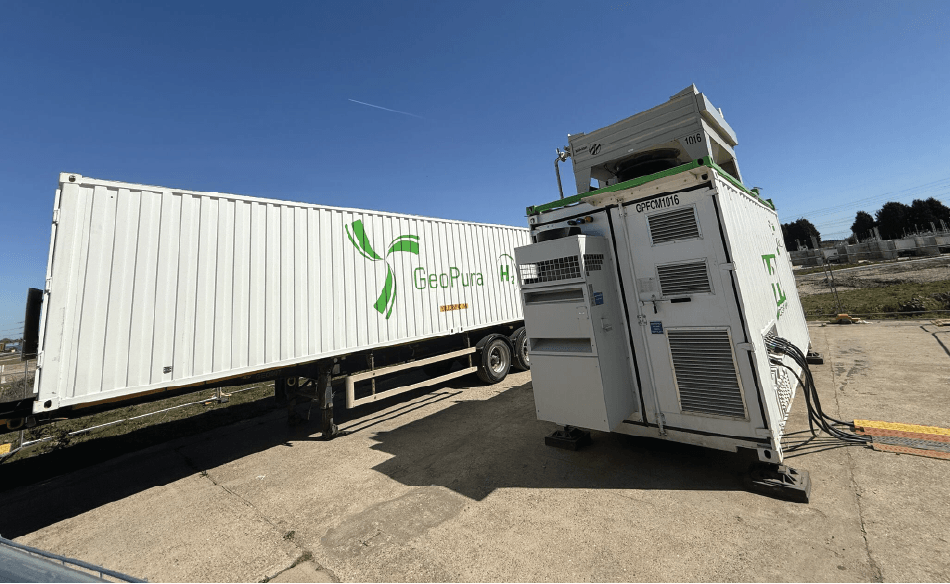
Senior Surveyor, Henry Mawhood, from our green energy and sustainability team recently visited HyMarnham Power, one of the UK’s first green hydrogen plants, and the experience offered a powerful glimpse of how hydrogen could support the transition to net zero. Seeing a former coal-fired power station being transformed into a clean energy hub was striking in itself, but what made the visit particularly compelling was the sense that this is no longer a distant concept. It is infrastructure being delivered now on a meaningful scale.
HyMarnham Power, a joint venture between GeoPura and JG Pears, is repurposing the former High Marnham coal plant into a low-carbon hydrogen hub. Powered by renewable energy and built around 15 MW of electrolyser capacity, the project demonstrates how legacy industrial sites can be reimagined for the clean energy economy. Its strategic location, with strong existing grid and infrastructure connections, also shows why brownfield energy sites may become increasingly important in the next phase of decarbonisation.
One of the most impressive aspects of the visit was learning more about GeoPura’s Hydrogen Power Units. These zero-emission generators are designed as a practical alternative to conventional diesel generation, supplying reliable power for construction sites, events, backup needs and off-grid applications. Because the units use hydrogen fuel cells rather than combustion, they produce no CO₂, no NOx and no particulate emissions at the point of use, with water as the main byproduct. That makes them not just an innovative technology, but a highly relevant one for sectors where diesel has long been considered unavoidable.
In the context of continuing geopolitical tensions and the wider risks that come with fossil fuel dependency, technologies such as green hydrogen feel increasingly necessary rather than merely experimental. Hydrogen’s value is not only environmental; it also lies in resilience, energy security and flexibility. GeoPura is already deploying hydrogen-based solutions into major UK projects, including the Lower Thames Crossing programme referenced during the visit, showing how hydrogen can help displace large volumes of diesel in real-world infrastructure delivery.
The bigger picture is that green hydrogen appears well placed to become an important part of the decarbonisation toolkit, particularly in sectors that are difficult to electrify directly. Heavy industry, long-haul transport, shipping, temporary power and flexible generation all require solutions that can deliver energy reliably, at scale and in locations where batteries or direct grid connection may not always be sufficient. Hydrogen also offers a means of storing renewable electricity and transporting that energy to where it is needed, helping address one of the central challenges of a renewables-led system.
There are, however, important questions around planning and delivery. Facilities like this need specific locations: sites with the right power access, room for industrial operations, strong transport connectivity and an appropriate planning context. In many cases, the best locations may be places that would not naturally be prioritised for other forms of development yet are ideally suited to energy infrastructure. If the long-term ambition is to create a wider network of hydrogen plants across the UK, planning policy and site allocation will need to recognise that reality much more explicitly.
Cost remains one of the most significant barriers. Today, natural gas is still materially cheaper in many applications, and green hydrogen is unlikely to scale at the pace required without policy support. In the UK, projects such as HyMarnham Power have been backed through the government’s Hydrogen Allocation Rounds (HAR) and the Hydrogen Production Business Model (HPBM), a government-backed framework which are specifically designed to bridge the operating cost gap between low-carbon hydrogen and incumbent fossil fuels over long-term contracts. While the long-term expectation is that green hydrogen costs should fall as production scales and technology mature, the reality is that many of these plants will only proceed if subsidy frameworks remain credible and investable.
For all that, the long-term vision remains compelling. Hydrogen is unlikely to be a single silver bullet for every part of the energy transition, but projects like HyMarnham Power show that it can be a serious, practical contributor to net zero when matched with the right infrastructure, planning support and commercial model.