

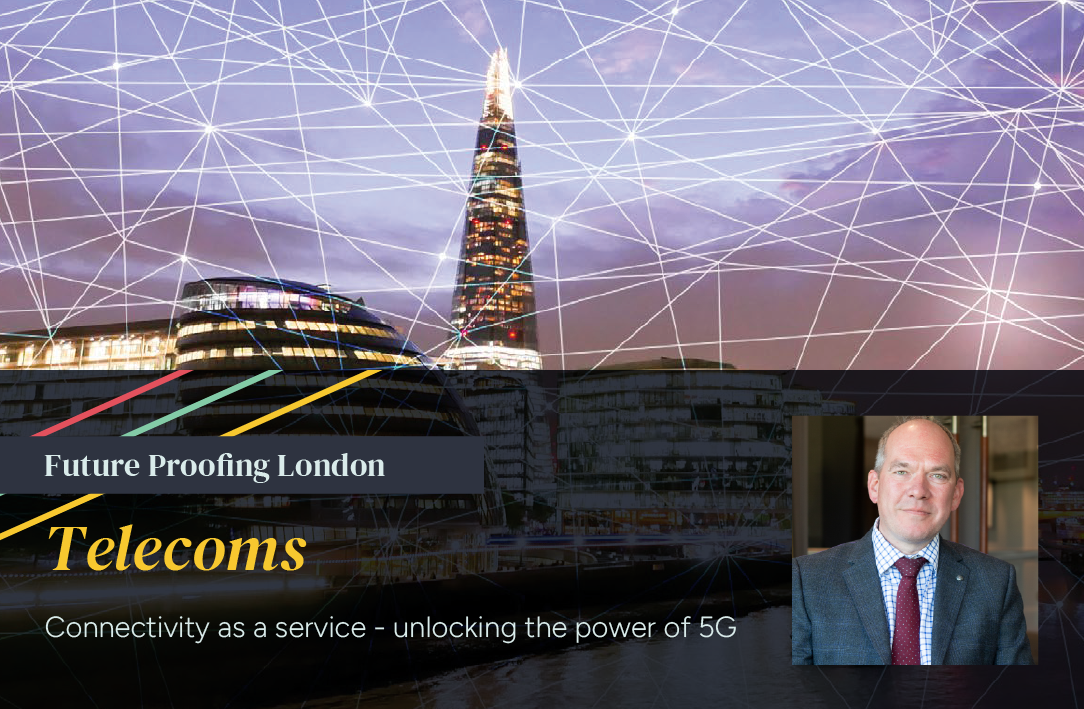
London benefits from a relatively advanced telecoms and mobile network, a foundation of modern life that most of us now take for granted. Yet, despite this, the capital languishes at the bottom of a newly published ‘5G Quality of Experience’ league table.
In an age when we can email, message, stream video, navigate in real time, manage our finances, and listen to music or podcasts, often all at once and from almost anywhere in the UK, reliable connectivity has become just as essential as water, electricity, and gas. Little wonder then that it is increasingly described as the fourth utility”.
The UK’s digital capability is poised for rapid expansion, driven by the rise of smart streets, intelligent transport systems, and a new generation of connected buildings. These advances, powered by Internet of Things (IoT) technology, will demand a step change in connectivity far beyond what is currently available in London or any of our other major cities.
Over the past three decades, mobile technology has progressed from the early days of 2G to today’s 5G networks, transforming how we communicate, do business, learn, consume entertainment, and deliver the digital infrastructure that underpins society, commerce, and government. The next wave of innovation will not just build on this foundation; it will depend on it.
However, current legislation has not helped landlords, many of whom host the infrastructure we all rely on. In fact, it is in danger of creating perverse incentives which undermine the future of connectivity in urban environments.
At present, there is a cap on the rent landlords can charge operators such as O2, Vodafone, and EE to host their equipment. While in rural areas this approach may have merit, ensuring network coverage reaches underserved regions, in cities like London the economic reality is very different.
Space is scarce, and the value of prime locations is high.When mobile infrastructure sites must compete with lucrative residential or commercial tenancy offers, the capped rents make them far less attractive to landlords. The result is predictable: many choose to prioritise more profitable uses, leaving operators struggling to secure the sites they need.
This is more than an operational inconvenience. It is a structural barrier to rolling out 5G, a technology that is up to 20 times quicker than its predecessor. The benefits extend far beyond faster downloads. For the creative industries, it means high-definition content can be shared and streamed instantly. For financial services, it supports the rapid, secure transactions essential in a global trading hub. For e-commerce, it enables seamless, real-time customer engagement. And for emerging technologies such as augmented reality, telemedicine, and autonomous vehicles, it is the very foundation on which they depend.
The challenge is that 5G requires far greater infrastructure density than 4G. More masts, more base stations, and more small cells are needed to deliver consistent high-speed coverage. This, in turn, means more locations and more willing landlords. If hosting mobile infrastructure were competitive and viable revenue stream, landlords would have a real incentive to participate. Removing or substantially increasingthe rent cap would unlock this potential, allowing the market to work in a way that benefits everyone. The public would gain from faster, more reliable connectivity. Businesses could operate more efficiently and innovate with confidence and the government’s ambitions for smart cities, and a digital economy would be far more achievable. Operators could then deliver on their 5G rollout commitments without being constrained by avoidable bottlenecks in access to sites. In short, there would be few losers.
Find out more about our telecoms consultancy services.
Read the full report - "The Smart City" and our new London office brochure.
Visit our London landing page.